Music from Three Centuries
“Unspectacular” organ recital delighted the audience in the church
November 11th, 2000
by Werner Brandt, Mainz Allgemeine Zeitung
translated by John H. Nisbet
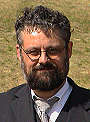 BINGEN – It’s almost unbelievable: In spite of little advertising, even “unspectacular” organ concerts find their audience. Indeed, the listeners in the well-attended Catholic Church in Büdesheim were more than rewarded.
Jürgen Rodeland arranged an interesting program, spanning the period from 1637 to 1992, accentuating the versatile sound of the Oberlinger organ, and fulfilling all expectations, both technically and artistically.
Felix Mendelssohn-Bartholdy’s 6th Organ Sonata began with chorale variations, which ornamented the melody, or treated it with toccata-like, brilliant scales, and arpeggios. The chorale theme was also hidden in the Fugue, but accentuated clearly, and the final movement exuded composure, and sensitivity, thanks to the soft registration of the performer.
In the Passacaglia D minor of Dietrich Buxtehude, Jürgen Rodeland spread out the variety of registration possibilities: the continuing bass theme was clothed attractively by very versatile, bell-like stops, silvery mixtures, and organo pleno. Only the conclusion turned out somewhat too modestly.
With Johann Sebastian Bach’s renowned Fantasia and Fugue in G minor, the artist could prove his enormous virtuosity. He played particularly the “Kaffeewasser” Fugue in a conception like an unbroken thread, held the tempo excellently, articulated very sophisticatedly, and registered transparently, so that the theme always remained clearly audible. He refrained from a grandiose ending.
Olivier Messiaen’s “Apparition de l’Eglise éternelle” began like clusters, using the swell box extensively, and contained sound expanses and rows of chords that could be suggestive of church windows flooded through by sunrays, but the composition revealed little structure, and too much emotion.
Max Reger’s Fantasia on “Ein feste Burg” turned out to be a masterpiece of the performer. If it would have been possible to sing the Chorale before, the appreciation of this piece would have been even greater. However, the information printed in the program, the very clear registrations, the well- played portato choral melody, the large contrasts of dynamics, the mastery of the difficult pedal part, and the great climax to the end: by all of these, a breathtaking interpretation was accomplished by being clear-cut, with a transparent sound despite the complicated chromatic harmony.
The enthusiastic audience demanded by much applause a well-known, exceptionally charming encore: Vierne’s “Carillon de Westminster” honored the listeners with a bell-like, playful sound.
©2000 Werner Brandt, reprinted in translation with author’s permission
For original article: click here