The full essay with links to historic organs restored by Oberlinger can be seen here.
The Usual Narrow Focus of the History of German Organbuilding
When international organ experts discuss the German tradition of organbuilding, significantly not more than two outstanding names of historic organbuilders, each one of them symbolizing a well-known historic organ style are mentioned: Arp Schnitger, representing the Baroque organ of Northern Germany, and Gottfried Silbermann, the principal builder in the Thuringian-Saxonian organ style, who is also connected closely with the famous name of Johann Sebastian Bach.
This somewhat narrow focus to the rich and sophisticated history of German organbuilding, neglecting the different styles of other regions, is based on the early “Orgelbewegung” in the 1920’s.
The Discovery of the Middle Rhine Organbuilding Tradition
The scientific and musical interest in other German organ styles came into being at least one generation later. The historic organ style to be introduced here, the “Middle Rhine Tradition”, was first discovered by Franz Boesken, who began his research for his monumental Middle Rhine Organ Survey in the late 1940’s. The result of his laudable life’s work, interrupted by his early and sudden death in 1978, is remarkable:
-
A monograph about the organbuilders Stumm, the most important historic workshop of our region, that existed for 6 generations.
-
Three volumes of his Middle Rhine Organ Survey with more than 2500 pages (the third one published posthumously). The fourth volume, containing more than 1000 pages, will be published in 2000 or 2001, more than two decades after his death.
-
A couple of essays about several organs and organbuilders, and about the foreign influences to the Middle Rhine Organbuilding.
Surely, the most important contribution by Franz Boesken was founding a basis for further research on the organbuilding history of the Middle Rhine in the following decades. In the 1990’s, three doctoral theses about three historic organbuilding workshops of the Middle Rhine were published:
-
“Die Orgelbauwerkstatt Schöler in Bad Ems” by Jürgen Rodeland, Musikverlag Emil Katzbichler, Munich/Salzburg 1991.
-
“Die Orgelbauwerkstatt Dreymann in Mainz” by Achim Seip, Orgelbau-Fachverlag Rensch, Lauffen a. N. 1993.
-
“Die Orgelbauerfamilien Engers und Schlaad in Walslaubersheim bei Bingen” by Manfred Wittelsberger, Musikverlag Emil Katzbichler, Munich/Salzburg 1994.
These three monographs complement one another to a cross-section through the Middle Rhine organbuilding tradition of two and a half centuries: from the founding of the Schöler workshop in 1748 (closed in the third generation in 1837), to the change of style in the 19th century (Dreymann, two generations working 1821-1862), to one of the longest surviving traditional manufacturers in the late 19th century (Engers and Schlaad, working 1810-1892, building mechanical slider chests until 1892).
The complete articulation of the Middle Rhine tradition has not been finished, and will never be finished. However, our actual knowledge at the beginning of the third millennium enables us to confirm that the tradition of organbuilding in the Middle Rhine is no less interesting than the traditions that gained scientific and musical interest previously in the 1920’s.
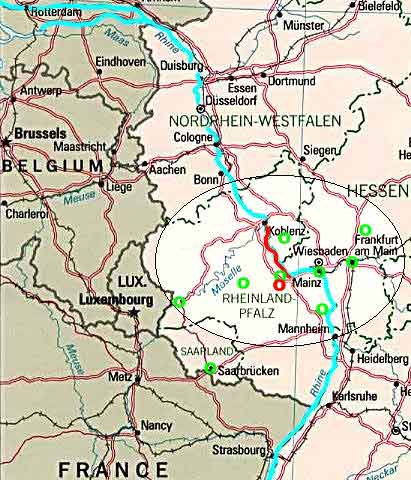 Geographical Definition
Before discussing the style features of Middle Rhine organbuilding, it is useful to define this area more precisely. The special meaning of “Middle Rhine”, i. e. the river valley between Bingen and Koblenz, containing some well-known tourist sites of interest like the famous Loreley Rock, would be too narrow as far as organbuilding is concerned. The Middle Rhine in this narrow sense is marked in red in the map at right. Franz Boesken had in mind a larger area that formed more or less a cultural unity in the recent centuries. This area, indicated roughly in the ellipse, is almost identical with the actual State of Rheinland-Pfalz, except its southern region, enlarged by the southern and western regions of the State of Hessen. The middle part of the Rhine river, including the navigable parts of its tributaries (Moselle, Lahn, and Main, the latter only till Frankfurt/Offenbach/Hanau) has been the infrastructural lifeline of our area.
The Most Important Historic Organbuilders of the Middle Rhine
The red circle in the map shows the location of Oberlinger Bros. Organ Building Company, that has been operating in Windesheim since 1860.(…more about the history of our firm).
The green circles indicate the locations of the most important organ building workshops of the region, all of them historic, and no longer in production:
- Johann Wilhelm Schöler, Christian Ernst Schöler and Philipp Gottlieb Heil in Bad Ems, in the east of Koblenz (1748-1837).
- Johann Conrad Bürgy and his sons in Bad Homburg vor der Höhe, in the north of Frankfurt (founded in 1764), split up in the 19th century to several successors in different cities, among them Carl Landolt in Alzey.
- Two dynasties of organbuilders in Trier (near the border to Luxembourg, city name not indicated in the map): Jean Nollet (early 18th century), his son Romanus Benedikt Nollet, and Wilhelm Breidenfeld and his sons in the 19th century.
- The large dynasty of Stumm in the village of Rhaunen-Sulzbach (in the eastern area of the red circle), working in 6 generations from ca. 1714/21 till ca. 1896.
- Engers and Schlaad in Waldlaubersheim (1 mile north of Windesheim), working 1810-1892.
- Many dynasties in Mainz, the capital city of Rheinland-Pfalz: Heinrich Traxdorf in the 1440’s, the Geissel family in the 17th century, Johann Jakob Dahm (naturalization in Mainz in 1698), Johann Anton Ignaz Will (since 1708), since 1727 Johannes Kohlhaas (father and son with the same name), also in the 18th century Johann Onimus and his nephew Joseph Anton Onimus, succeeded by the organbuilders Flügel, Franz Ripple, and in 1821 Bernhard Dreymann and his son Hermann, succeeded by Finkenauer & Embach until the late 1860’s.
- Many dynasties in Frankfurt: Brother Leonhardus Merz (second half of 15th century), the Graurock family in the late 16th and early 17th century, Johann Christian Köhler (naturalization in Frankfurt in 1753), after his early death in 1761 his fellow Johann Georg Linck until 1762, from 1762 on Köhler’s stepson Philipp Ernst Weegmann, and later, the latter’s son Johann Benedikt Weegmann.
- Johann Georg Geib, until 1790 in Saarbrücken in the very south of our region, and since 1790 in Frankenthal (between Mainz and Mannheim).
Cultural Character
The mind-set of the people living in the Middle Rhine area has been influenced by several typical features of the region.
The Rhine river, a strong traffic lifeline, has given them the opportunity to contact their neighbours easily, and to be influenced by them, for hundreds of years. As far as organbuilding is concerned, the style has developed continuously by the integration of foreign characteristics. Many organ builders travelled along the Rhine river into the region, and enriched it with ideas they had learned in their home countries. In the 15th and 16th century, the main organbuilding influence came from the Netherlands. Later, from the 17th until the 19th century, the region received important influences from France and Alsace, from Switzerland, and from Westfalia. Needless to say, Middle Rhine organbuilders influenced their neighbours, too.
The largest cities along the Rhine river and its tributaries have an extremely rich history. Founded by the Romans two millennia ago, they became centers of cultural life in the following centuries, documented for example by the large cathedrals. The most important cities to be mentioned here are:
-
On the Rhine river, from the north to the south: Cologne, Mainz, Worms and Speyer (not indicated on the map, both between Mainz and Mannheim), and Strasbourg.
-
On the western border of the area: Trier on the Moselle river (indicated as a green circle near the border to Luxembourg).
All of these cities have been flowering centers of culture, arts and handcraft, and most of them were resident to dynasties of organbuilders.
Last, but not least, the region is characterized by its fertility, especially for vineyards. Some important German wine regions, each of them with their own, sophisticated character, are located here: The “Rheingau” (on the north bank of the short horizontal part of the Rhine between Wiesbaden and Ruedesheim), “Rheinhessen” (in the southwest of Mainz), “Moselle”, and “Nahe”.
The triangle of the river lifeline, the history, and the fertility of nature, determines the character of the people living in the Middle Rhine area: They are open-minded for cultural influences, they are proud of their rich history, and they enjoy their life.
Features of the Middle Rhine Organbuilding Style
It is not possible in this brief introduction to show the wide, sophisticated variety of the Middle Rhine organbuilding tradition in detail.
The typical features of Middle Rhine organs are these:
Site of the divisions and the playing console: From the second half of the 18th century on, almost all Middle Rhine organs have lateral playing consoles, and their facades are part of the balustrade of the gallery. This kind of organ installation provides many advantages: Best acoustical conditions for the direct, and unreflected development of the organ sound; best visibility of the organ, causing a nice harmony of the church and organ architecture, simple mechanical action, and good visual contact of the organist to the altar area.
In most Middle Rhine organs, the pedal division is located behind the organ case. It has few pipe ranks, all of them made from wood, and giving a fundamental sound basis. The manual divisions are located in the visible organ case. Their windchests can be installed in a vertical sequence (usually the Great in top, and the Positive under the Great), or in an horizontal one, but never behind each other.
Location in the church room: This depends on the confession. In historic Catholic churches, the organ is always installed in the rear (west) gallery. In some Evangelical churches, the organ is located in the direct view of the church visitors, and is part of the architectural unity “altar-pulpit-organ”, representing the theological terms “sacrament-word-praise”.
Casework and ornaments: Of course, the casework design changed in the 19th century, and became supraregional in these times. Therefore, a typical Middle Rhine organ architecture can only be described for the 18th century. All Baroque and Rococo organbuilders in the Middle Rhine area used a kind of modular system for the architectural design of their organ cases. The basic elements of this system are few forms or pipe fields and pipe towers: Round towers (in our area always based on a semicircle), pinted towers (triangle basis), segmented towers (rarely, and only in the early 18th century), flat towers, and – very typical – flat fields and towers in harp shape. All these elements can be combined with each other in very different orders and sizes. This gives the Middle Rhine organ cases a great variety, that differs from the more standardized architecture of other regions, for example Northern Germany. Also, the modular system enabled most of the organbuilders in the Middle Rhine region to elaborate a well distinguished personal style.
The ornaments were usually carved from lime wood. Our typical ornaments are pipe shades, and large wings (in German: “Ohren” = ears) on both sides of the facade. As distinct from many Baroque organ cases in Southern Germany (Bavaria) and Austria, the ornaments never overgrow the architectural “modular system” structure. In this point of view, the Middle Rhine style stays between the standardized, “Evangelical” style of Northern Germany and the overflowing, “Catholic” one of the Bavarian-Austrian region.
Some Middle Rhine organ cases built until the 1760’s have large carved statues, for example King David playing his harp. In the following decades, smaller figurines were carved, and even later, these disappeared as well.
The front pipes are usually made from 78 % tin, with decorative raised lips, and are neither gilded or painted.
Technical system: Usually, the Middle Rhine organ builders of the 18th and 19th century worked very traditionally in the technical point of view, building mechanical slider chests until the very end of the 19th century (for instance Johannes Schlaad, who never built cone chests). However, they didn’t totally reject new inventions. Some examples:
- In 1870, the young 6th generation of the Stumm family built their first cone chest, while their father made a business trip, and afterwards, all Stumm organs were built with mechanical cone chests.
- Bernhard Dreymann built only one cone chest (Pedal division in Gau-Algesheim, 1853). However, he sometimes built an innovative slider chest construction: The “durchschobene Lade”, a common windchest for two divisions with an alternating sequence of the ranks of both divisions.
- Johannes Schlaad received a patent for his invention “Windlade für Orgelwerke mit einer Klaviatur”, a windchest for organs with one manual, enabling the organist to switch quickly from a loud registration to a soft one, and the other way round.
- The second generation of Breidenfeld invented a mechanical registercancel chest with vertical balanced lever pallets, a strange curiosity.
Specifications and typical stops: The specifications of Middle Rhine organs built in the 18th, and early 19th century have some common features, even in the smallest organs.
- The principal chorus of the Great division is always complete: In small specifications 4′ + 3′ + 2′ + Mixture, in larger ones + 8′, in largest ones + 16′. Many principal choruses also contain the Third (1 3/5′). The Quint 1 1/3′ in Positive divisions repeats on 3rd c to 3′.
- The flute chorus contains at least a Stopped Diapason 8′ (called “Gedackt”, or “Bourdon”, or “Copula”, or “Rohrflöte”, etc.) and a Flute 4′. A very typical Middle Rhine stop is the “Flaut travers 8′ Treble”, built in sophisticated varieties by different organbuilders. For example: pear tree wood, not overblowing (Stumm family), or tin, different pipe body forms, semicircular upper lip, overblowing and/or sharp (beating stop, Schöler family).
- The reed stops are usually Trompete 8′ (evtl. + Vox humana 8′) in the Great, Krummhorn and/or Vox humana 8′ in the Positive, and Posaune 16′ with full-length wooden resonators in the Pedal. A typical Middle Rhine reed stop that only can be found here is Vox angelica 2′ Bass (in the first two octaves of the Great manual). Almost all manual reeds are divided between 2nd b and 3rd c, even in organs with more than one manual division. The reeds are strongly influenced from France.
- Most typical stops are the strings that only might be lacking in the smallest organs. Viola da gamba 8′ with very narrow pipe scales, and without any voicing submission by pipe ears, starting to sound very slowly, and imitating the scraping of the bow; Salicional 8′, 4′, and 2’/4′ (that means: first c – second b 2′, and from 3rd c on 4′). Also stops like Gemshorn 8′ and 4′, and Quintade 8′ are very common in the Middle Rhine. Their function is somewhat between the string chorus and the flute chorus.
Large Great divisions can contain a Cornett with 5 ranks, built additionally to the single Terz (Third) 1 3/5′.
The main function of the Pedal division is the very fundamental bass. Therefore, small Pedal stops (2′ and smaller) and Pedal Mixtures are rare, and appear only in the largest organs.
Epilog
This brief history cannot be more than an introduction. If you have been interested in the matter: Don’t hesitate to travel to the Middle Rhine – listen, play, feel, and experience first-hand!
| John H. Nisbet, U.S.A. representative of Oberlinger Bros. Organ Building Company |
Jürgen Rodeland, Director of the Restoration Departmentin Oberlinger Bros. Organ Building Company |
© 2000 John H. Nisbet and Dr. Jürgen Rodeland