In 1846, when First Presbyterian Church moved from Wall Street to its current location on Fifth Avenue, sacred music in the worship service was very different from what we know today. First Presbyterian, like many 19th-century Presbyterian churches, was a conservative congregation, and no musical instruments were allowed in the sanctuary except for the human voice. At this time, choral music in most American churches was provided by a solo quartet, as was the case at First Presbyterian. In the conservative tradition of First Presbyterian, the quartet was only allowed to sing unaccompanied metrical settings of the Psalms from the musicians’ gallery in the back of the church. Since instruments were not permitted in the sanctuary, the quartet had to retire to a room in the belfry to get pitches from a pitch pipe. However, the quartet was allowed to sing the works of Palestrina, Vittoria and Orlando di Lassus in the chapel, but only as entertainments and never at worship services. In general, there were many rules on how Presbyterians were to conduct themselves, and it was considered a sin to speak in the sanctuary after the service.
As early as 1855, the session wanted to install an organ in the sanctuary to attract younger worshippers, but James Lenox, ruling elder and controlling financial supporter opposed the idea of a musical instrument in the church. James Lenox reasoned that since his father, Robert Lenox, who had given the land on Fifth Avenue, had not worshipped with an organ, the congregation did not need one. In 1887, seven years after James’ death, the session finally voted to purchase an instrument from the premier organ builder, Hilborne Roosevelt, at the cost of $12,000. The organ was installed in the rear gallery in 1888, and was considered the finest in the city and received wide attention. The first men to play the organ were Mr. Henry Belden and Mr. Sumner Slater. Little is known about their training or what they played. Dr. Harlan, pastor at that time (1886-1890), writes…”As long as this [organ] had taken place it was now time to take off the brakes, and that instead of having the same as formerly, they would now put on some trills and frills which they otherwise previously had not had.” The congregation was divided over the trends that were taking place.
Major changes began to take place when, on December 1, 1891, Dr. Duffield, a strong visionary leader with progressive ideas and a lover of music, was installed as pastor. In March of the following year, William C. Carl at age 27 was employed as the first Organist and Choirmaster. Duffield and Carl had met a few months earlier onboard a ship returning from Europe. Carl had just completed an extended stay in Paris, studying with the world famous organist, Alexandre Guilmant. Born in Bloomfield, New Jersey, in 1865, Carl had already established himself as an organist before going to Paris, and in 1882, had been appointed organist at First Presbyterian Church in Newark, New Jersey.
Immediately after his appointment in March of 1892, Carl began a series of organ recitals that were so successful, the church was filled to capacity at most concerts and the police had to control the crowds on Fifth Avenue. During this era, Dr. Duffield and Carl presented concert versions of Parsifal to overflowing crowds at the church, since copyright law prevented production of the opera at the Metropolitan Opera. Full production of Parsifal was allowed only at Bayreuth.
As more churches were built in the latter part of the 19th century, the number of organ builders in America increased to meet the need for musical instruments, and many fine instruments like the Roosevelt Organ at First Church, were built. However, there was a lack of well-trained organists to play these new, impressive looking and sounding instruments. While recently established music conservatories and schools in America taught some organ, the serious student traveled to France and Germany for training.
William C. Carl, like many American students, went to Paris to study with Alexandre Guilmant and the two became life-long friends. Guilmant (1837-1911) came from a long line of organists and was not only known as a great teacher, but as an organ virtuoso and church musician. Guilmant toured America three times, performing in major churches and concert halls, and played forty recitals at the St. Louis 1904 Exposition. Since the American public had never heard or seen organ playing like this, Guilmant immediately became a celebrity. He performed several times at First Presbyterian, and Walter Damrosch referred to him as “a wizard of the organ.” When a passage was played with his feet alone, the audience was wild with excitement.
Guilmant was organist at La Trinité, Paris (a position Messiaen held later), and taught at the Paris Conservatory. In 1894, he founded, along with other colleagues, the Schola Cantorum in Paris, a school for training church musicians. Guilmant’s stylized playing is best described as having a singing, clean, legato line. His method of teaching was revered, and he paid close attention not only to organ playing technique but to the poetry of the music, as well. He was married, with two daughters and a son, who was a painter. The whereabouts of a portrait of Dr. Carl by his son is unknown today. Guilmant was a prolific composer, and his wife ran the family publishing business. He is characterized as a tireless worker.
In 1898, during Guilmant’s second American tour, Carl and Guilmant decided to open a school for organ instruction in New York based on the master’s method of teaching. In 1899, Dr. Duffield invited the Guilmant Organ School to open at First Presbyterian Church with the magnificent Roosevelt Organ as the centerpiece for lessons and recitals. The first class was held on October 9, 1899, in the chapel. Guilmant was the President, Carl was the Director and Instructor of Organ, and Dr. Duffield was the Chaplain and Instructor in Theology. The following excerpt from the initial announcement gives a clear idea of the purposes of the school.
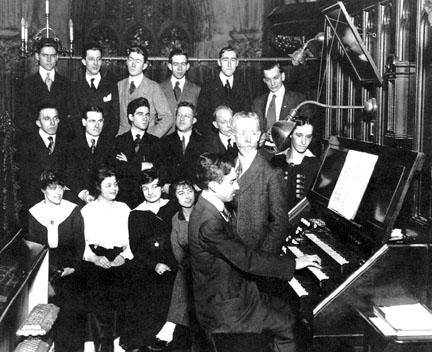
William C. Carl having been authorized by Alexandre Guilmant to open an organ school under his patronage begs to announce the Guilmant Organ School, in which the method as set forth by the great French organist, will be taught. Since the phenomenal success of M. Guilmant in America, a new impetus has been given to the organ as a solo instrument and in its relation to the church service. Organists in all parts of the country are giving more attention to its study and in the preparation of their work. Organ concerts are in demand with a growing success. Church committees are exacting a higher degree of ability from their organists and the press is giving it attention.
These facts have demonstrated to Mr. Carl the necessity of such a school, where the organist will receive a practical training for the church service and a more thorough understanding of the ecclesiastical music.
The Guilmant Organ School at First Presbyterian Church quickly became one of the leading institutions for the study of organ and church music in America. The school awarded a diploma after two years of study, and courses were offered in private organ instruction, general music studies, and theology. A silver and gold medal designed by Tiffany was awarded to the graduate of each class with top honors. In addition to Dr. Carl and Dr. Duffield, local organists and other musicians served as faculty members. Two notable men associated with the school were Robert Hope-Jones, an American organ builder, and Dr. Clarence Dickinson of the School of Sacred Music at Union Seminary, who served as an examiner. In 1915, six scholarships were established, so that students from across America could study at the school.
Through the years, Dr. Carl and the Guilmant Organ School gained international recognition. The French government bestowed on him the Officer de l’Instruction Publique, and he was made a Chevalier of the Legion of Honor in recognition for his work in promoting the works of Guilmant and other French composers. New York University conferred on him an honorary Music Doctorate Degree.
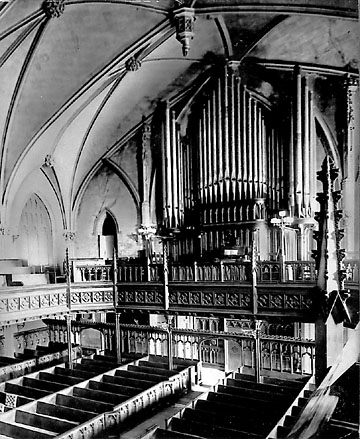 The impressive Roosevelt Organ was used until 1918, when it was replaced with an E. M. Skinner Organ located in the newly constructed choir loft in the front of the church. The Skinner, which was rebuilt in 1928, was eventually replaced in 1964 with the current Austin Organ, which incorporates some pipework from the Roosevelt and Skinner instruments. This past year, this instrument was cleaned and tonally regulated by the firm of Glück Orgelbau, Inc.
The 25th anniversary of the Guilmant School was celebrated in 1924. 150 Students had graduated from the school, and 26 of them were in responsible positions in the greater New York area.
To celebrate Dr. Carl’s 40th anniversary as Organist at First Presbyterian in 1932, the church installed a bronze plaque in the choir. In 1935, Dr. Carl was granted a leave of absence from his duties at the school for health reasons, and Willard Irving Nevins, Carl’s first student and associate, became director of the school. On December 8, 1936, Dr. Carl died and in January 1937, Mr. Nevins was appointed Organist and Choirmaster of First Presbyterian Church.
Under Mr. Nevins, the school continued its fine service in the field of church music. With a view toward solidifying the position of the school in the education scene, Mr. Nevins arranged for incorporation of the institution, in 1940, under the laws of the State of New York. The school was later approved under the regulations of the University of the State of New York, in order that colleges could give credit for work done in the school.
In 1956, Willard Nevins retired as Organist and Choirmaster at First Presbyterian, but remained director of the school until his death in 1962. On January 18, 1960, the school celebrated its 60th anniversary, and a gala dinner was held in the newly built Church House (now the Mellin-Macnab Building). In March 1963, Dr. George Markey, Organist and Choirmaster of Madison Avenue Presbyterian Church, became the third director. At this time, the school left First Presbyterian. Dr. Markey’s dream was to recast and update the school in order to compete with major American music conservatories. The school continued to receive much attention, when in 1965, the Guilmant Organ Festival was held on the new Aeolian-Skinner Organ in Philharmonic Hall (Avery Fisher Hall), Lincoln Center. However, after leaving First Presbyterian, the school never found a permanent home, and closed in the early 1970s.
The Guilmant Organ School was an institution with high standards that successfully trained young organists to go forth and serve congregations throughout America. One hundred years ago, the congregation of First Presbyterian Church made a commitment to the educational development of church musicians in America, and many students learned to play and refine the art of organ performance in the church’s sanctuary. Today, graduates of the school speak fondly of the time they spent studying at the school and First Presbyterian. As we enter the 21st century, it is important to remember and give thanks for the strong witness of the forebears of this congregation, a congregation that began nearly 300 years ago. To commemorate the hundredth anniversary of The Guilmant Organ School, a series of three organ recitals has been presented in 2000.
© 2000 William F. Entriken